
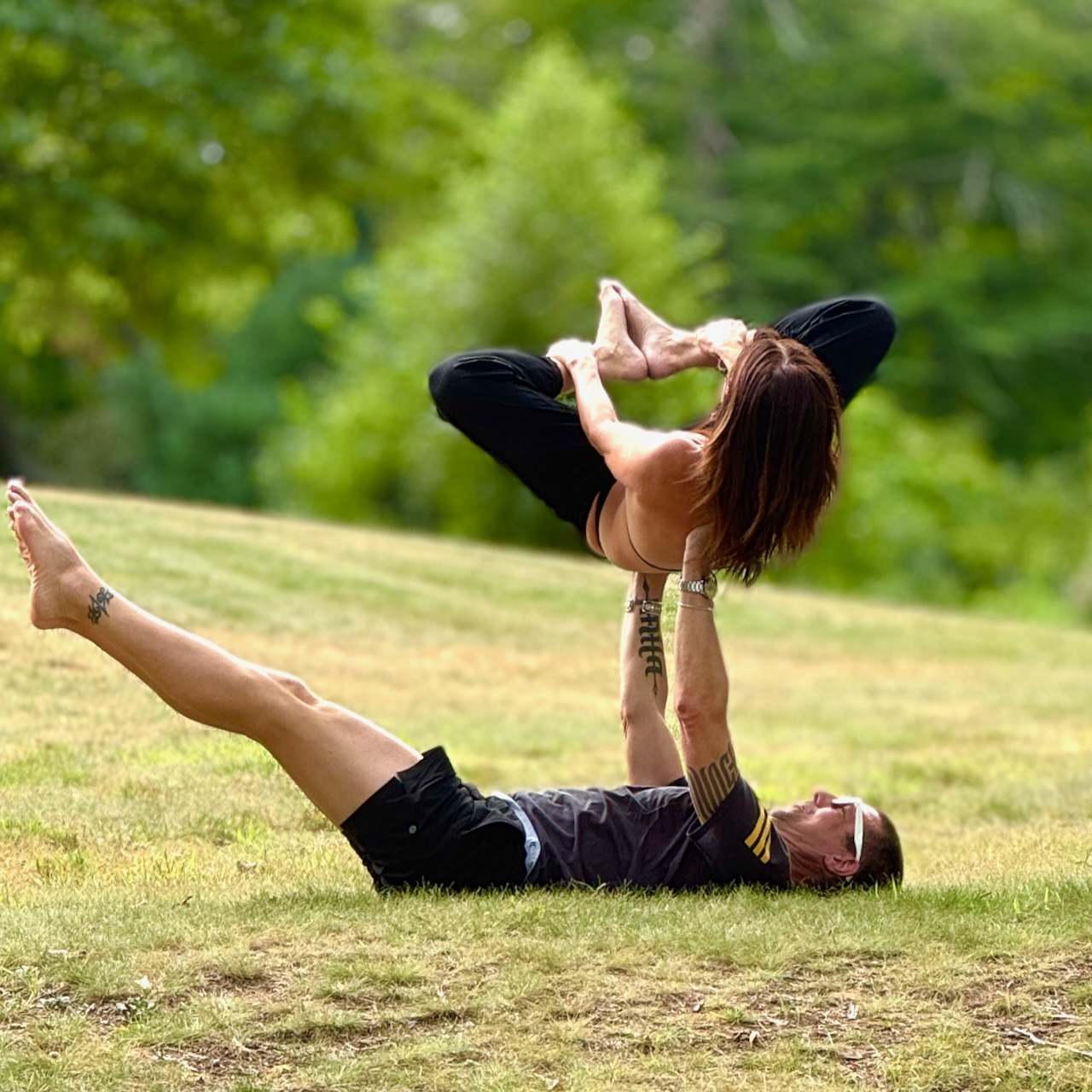
Much is written these days about “daily habits of successful founders.” But not so much about Founder Calibration. Working full time for most of the past year with my partner Graceann Bennett on Graxxia Holy Water, we have adopted many of these patterns — primary amongst them waking up before sunrise — but by far the most profoundly effective routine has been a bit unconventional: 15-minutes of partner yoga practice, a.k.a acroyoga, every day before the workday begins.
We had been doing early morning gym workouts for a while before arriving at this breakthrough. I am a former acroyoga teacher; it is one of my favorite physical activities. Then one morning as we lifted weights, I thought : “it can’t hurt to ask.” So I asked Graceann if she would try some counter balancing and flying with me. She asked a few questions, consented, and that’s how our founder calibration practice truly began.
There are two primary roles in acroyoga: the base and the flyer. The base is rooted to the ground; the flyer… flies. The base is stable; the flyer is dynamic. The total flow of base and flyer is a serious trust play.
First Flight : a Rough Takeoff
That first day, we had a lot of kinks to work out. Untested, we struggled mightily with balance; our “flow” was non-existent. I did my best to describe the obscure body postures and movements required of her while she was hanging upside down in precarious positions. I slipped often; she fell a few times. That first session was awkward, to say the least.
And yet. The workday that followed, we killed it. It felt like, at times, we were reading each other’s minds. Our efficiency was at least 2x; we debated less, and executed more. Our work day was, put simply: in flow.
Since then, while sporadic, our partner acroyoga practice has improved vastly, as has our executive alignment.
And really, that’s the secret sauce: Alignment.

Founder Calibration : Matching Breath
In our practice, we begin with a very basic founder calibration. Before we engage in more advanced flying maneuvers, we stand firm facing eachother, grasp opposite hands, and lean backward. We aren’t’ warmed up yet, so everything is done in slow motion. We move with power & control. Intentionally. We match our breathing. As in martial arts: perfect a move in slow motion. Work out every kink. Gradually increase the speed. This is how we balance. Both the movement, and the breathing. We match our breathing to our movements to our pushes to our pulls. We enter a rhythm. You can almost feel two becoming one. Alignment begins.
Graceann, amongst her many talents, has a way of reducing complex and abstract concepts into easily digestible soundbites. One of her recent classics, articulating the pure essence of founder calibration, is:
“More Alignment, Less Effort.”
Amazingly, this exact statement is a core truth of acrobatic practice: when you first execute a move, you have to use maximum strength to accomplish it, managing lift and balance and instability and misalignment all at once. But every time you execute the move, your body learns — through trial and error and micro-movements — the most efficient way to execute. Turns out, in most cases, raw strength is not the answer. Alignment is. If you align your structure — your bones — to optimally support the move, then that innate stacked structural strength can support far more weight than you can actively lift using muscle power alone.
And this same concept applies to our business as well: we pick aligned customers, vendors, and partners; we align our choices of systems and structures with our end goals in mind. Friction is reduced. Less energy is spent getting everyone on the same page. More energy is spent executing, and moving the entire project and team forward towards the end zone.
There are so many components of this physical practice that we find valuable and informing to our company. Alignment. Synchronization. Playfulness. Perhaps most especially, trust and non-verbal communication.
Trust is key. Even in the simple move: the lean back pull. We both commit, full send. Sometimes one of us pulls more; sometimes one of us overcommits. Sometimes one of us is feeling insecure, and doesn’t commit enough. You feel the result of any of these mis-alignments, immediately: it manifests as a fall, preceding possible physical injury. No one wants to get hurt. So we communicate, express what we are feeling, and ask for what we need. The partner form is corrected. Greater stability is achieved.
Greater stability of the unit increases mutual trust. Greater trust allows for more daring moves, fuller commits. We lean back further; we lean back in synchrony. We both lean past the point of no return — if either of us were to freak out or jerk, the other would fall and potentially injure themselves. But we have practiced. We have learned to trust. And with complete trust, comes complete commitment. And then comes the complete expression of the form. And the complete expression is: maximum presence, aligned immediacy, flawless execution, and elegance of flow.

Non-Verbal Communication : Bodies Speak
Finally, there is the magic of non-verbal communication. Acroyoga is, in its very essence, a physical practice rooted in dynamics, immediacy, flow and improvisation. Which is pretty much the definition of what we deal with in a startup, every day. When Graceann and I began our founder calibration practice together, there was a lot of talking: questions, answers, instructions, clarifications. Explicit verbal communication about what worked and what wasn’t. That was necessary. To work out the kinks.
But with repetition, you find grooves. You learn eachother. You learn each others weaknesses, and strengths. You learn to feel — with your body — when there is danger, and when there is is security. You talk less. You move more. Your body learns to listen to subtle physical cues : a base’s hand here means to twist like this. A flyer twisting her hip this certain way means she wants to go left, not right. All in real time. All without words.
Two decades ago, I co-founded a computer vision startup called PlayMotion, and ran it for close to 8 years. Ostensibly, our mission was to teach machines to “see” like humans, using high-speed machine vision cameras instead of eyes, and nVidia GPUs running our custom software instead of brains. Once we had solved the basic puzzles of how to track humans and their poses in real time, I became very interested in the next level of intelligence: could we train the machines to read gestures across time, and thus read body language? It was certainly a most worthy challenge.
So me? I took a deep dive, and learned all I could about body language. And one of the most compelling ideas that I encountered in that research was: 90% of all communication is non-verbal. this idea fascinated me. Up until then, my understanding of a meeting (like AI today), even when I was physically present, was essentially a reading of the transcript. Just the words. Learning about body language, I began to study the room. And over time, I began to actually trust my eyes and nose more than I trusted my ears. I learned that while people may tell the truth sometimes and lie sometimes with their words, that their bodies almost never lied. transcripts were deceiving; bodily movement told the truth.
Which brings me full circle to my co-founder and I, and our morning acroyoga practice. One of the most important and hard-to-articulate rewards of the practice is: our bodies are aligned. Aligning our bodies and breathing — and getting them to fluidly execute both halves of a complicated acrobatic dance — prepares us to be aligned in our workday.
Think of it as a physical hack, a bodily shortcut — where 15 minutes of founder calibration via silent physical alignment gets better results than 150 minutes of verbal discourse and strategy debate.
So that’s our practice. It works for us. Would it work for you? What do you think? Let us know, or just send us a video of your physical practice.
We hope that sharing this delivered some value to you along your journey.
Let the dance begin.
